
In May 2025 Feld moved its Magento shop to us from another agency: two storefronts, around 85 custom modules, product configurators that price every order individually, an ERP that takes the orders, and 46 open items in the old Jira.
We took over code, pipeline and operations and shipped the first release 24 days after the code moved in. In the 18 months since: 99 releases, seven new configurators, Hyvä CMS for the content team, business monitoring, security hardening and a performance round measured change by change.
Maschinenbau Feld GmbH cuts, bends, rolls and welds sheet metal in Eitorf, North Rhine-Westphalia. On feld-eitorf.de, customers order sheet cut to size, bent profiles, roofing flashings, laser-cut parts, tubes and shower trays, all in their own dimensions. A second shop, metallgarten.de, sells Corten steel planters and garden objects from the same Magento instance.
Most product pages are configurators. The customer enters dimensions, picks material and thickness, and the shop calculates weight and price live, draws the part and sends the finished order to the ERP and on to production. Customers rate the shop 4.93 out of 5 on Trusted Shops, across more than 41,000 reviews.
 feld-eitorf.de: three configurators right in the hero. Click to enlarge.
 metallgarten.de: the second brand, same Magento instance, own Hyvä theme.
Feld came to us with a Jira export of 46 open items, the code and the documentation of the previous agency. We opened a GitLab project in early May 2025 and moved the open work over, so nothing from the old backlog got lost. The code followed on 23 May.
What we found was a solid base with a lot of custom code: Magento Open Source 2.4.7 with a Hyvä frontend, around 60 Feld modules plus 27 modules the previous agency had built, an integration with the Bendex sheet bending configurator, an openTRANS XML order export to the ERP, and Storyblok as the CMS.
Since then the project has seen more than 1,700 commits, 379 merge requests and 99 tagged releases. Changes go to staging first, where Feld tests and approves them before they go live.
Every configured part has its own rules: minimum and maximum lengths, which bends fit which thickness, what the technical drawing is called on the order. Getting those rules right is what keeps orders producible.
 Seven new configurators: valley flashing, eaves flashing, verge flashing and free sample sheets in August 2025, a rectangle configurator in February 2026, laser-cut trapezoids in July 2026 and a corner profile in September 2026.
Existing ones extended: shower trays with up to four drains, a "grind weld seams" option for custom frames, rings that can be split in the middle, new constraints for troughs and Z-profiles, and drawing names that follow the configuration.
Orders the ERP can read: the openTRANS order XML now carries the Bendex ID, the item index, the weight of each item and the express delivery time, so production gets what the customer configured.
Tested end to end: Playwright tests cover the purchase flow, adding a configured part to the cart and the 3D preview, on top of PHPUnit unit and integration tests.
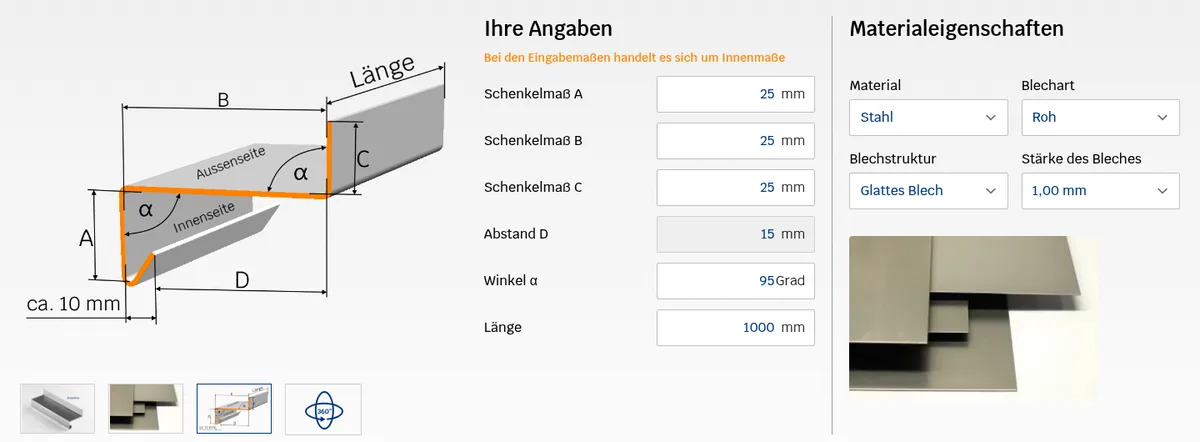 Bent profile configurator: the drawing labels every dimension the customer enters. Click to enlarge.
 The price is calculated live and broken down into material, cutting and bending costs.
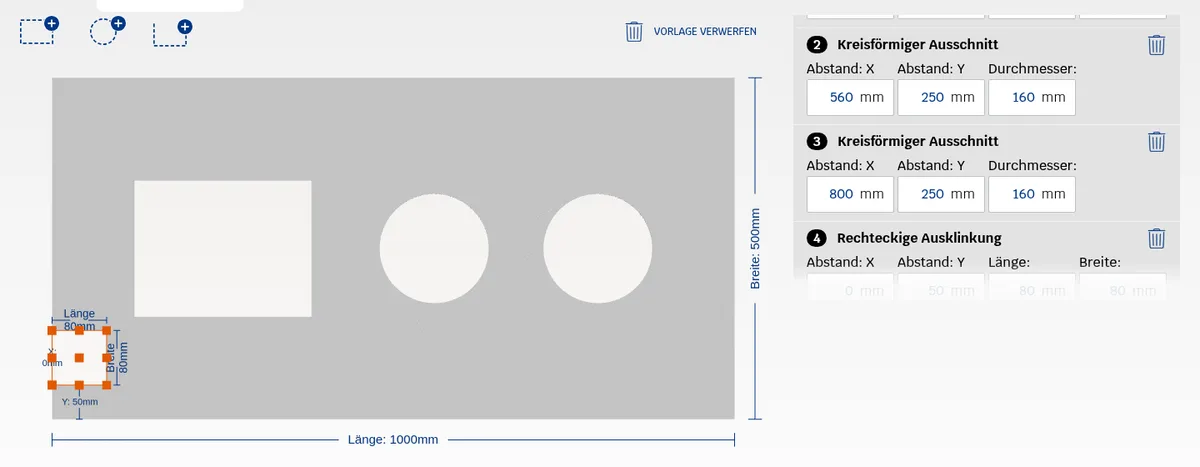 Laser cut configurator: cutouts and notches placed by drag and drop or by the millimetre.
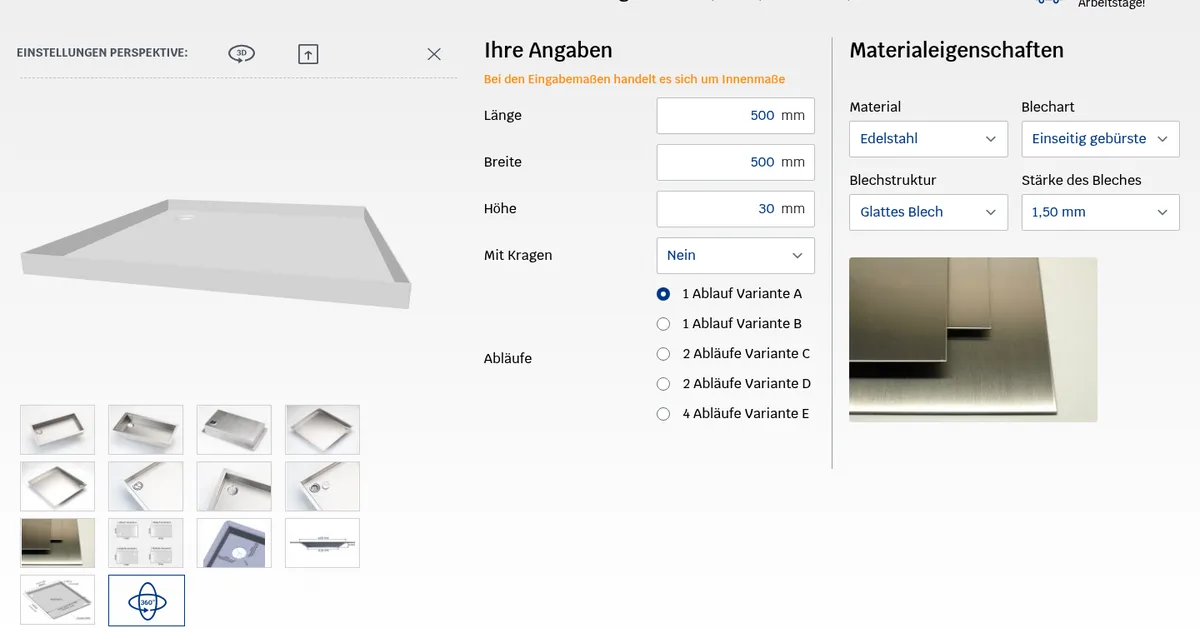 Shower tray configurator with a live 3D preview and five drain variants.
Shop content lived in Storyblok, a separate system next to Magento. In autumn 2025 we evaluated Hyvä CMS on staging with Feld's team. The first test pages worked, but the team still needed custom CSS to match their style guide.
So we built a component library first: a style guide page where every element and component follows Feld's design out of the box, plus custom components such as info tiles, category tiles and a product slider. After that the footer, the USP bar, the 404 page and the category content blocks moved to Hyvä CMS. Feld's team now builds and changes pages without HTML, CSS or a ticket for us.
In November 2025 a wrong tax configuration reached the live shop. We wrote a post-mortem, went through it with Feld and did the preventive work at no charge:
Then we added monitoring that watches the business, not only the servers. Our open source Prometheus exporter feeds a daily and weekly report in Slack with orders and revenue compared to the previous week, and the message carries a warning when the numbers drop.
On the technical side, Tideways tracks server time per release and Sentry has collected errors since May 2026. Each month we turn the loudest Sentry issues into tickets and fix them, from a locked cart during order placement to a chat widget that would not load.
The monitoring also caught one of our own. In August 2026 the configurator hung now and then, at random times of day. The cause was the metrics cron: four of its counters read the full order tables every minute. We fixed it in the exporter itself, released version 4.3.0 and cut the database load of that cron by about a factor of six.
Patches on schedule: twelve rounds of Magento security patches and dedicated hotfixes since the handover, each tested on staging first. The shop now runs 2.4.7-p10.
Fast response: when Sansec published the StyleSmuggler attack on 6 September 2026 and no Adobe patch existed yet, we analysed the exposure with Maxcluster the next day. Adobe's patch was live on the shop the day after.
Inherited code reviewed: in the Bendex integration we replaced unserialize() with JSON, fixed a weak password hash in the user sync and removed a legacy MD5 path.
Checks in the pipeline: gitleaks, Semgrep and composer audit run on every merge request. PCI DSS script integrity in the checkout, the findings of the PCI scan, a security.txt and 119 npm advisories in the build tooling are done.
Early on we found navigation icons uploaded at up to 1500 × 1270 px and displayed at 64 × 64 px, about 500 KB each. Resizing them saved most of that weight on every page.
In October 2026 we ran a dedicated round on server time. Tideways showed that four page types used 82% of it: category, search, product and "page not found". We released one fix at a time and compared each one before and after on the live shop:
| Server time | 12 Oct 2026 | 19 Oct 2026 | Change |
|---|---|---|---|
| Search page, average | 2,365 ms | 650 ms | -72% |
| Category page, average | 1,242 ms | 752 ms | -39% |
| Product page, average | 1,058 ms | 859 ms | -19% |
| Whole shop, average | 712 ms | 541 ms | -24% |
| Whole shop, slowest 5% | 1,879 ms | 1,239 ms | -34% |
Source: Tideways, 24 hours of live traffic each, before the first and after the last change.
How we measured each change, and what every single fix brought: the full performance case study with Tideways.
The developers got faster too: the staging pipeline went from 40 minutes 52 seconds to 33 minutes 29 seconds.
November 2026 started a mobile round: 25 small tickets, from a number keyboard for the size fields and address autofill in the checkout to help after a search without results. The first are tested on staging and ready to ship.
On the infrastructure side, the search engine, RabbitMQ, Varnish, MySQL and Redis are planned for supported versions ahead of their end of life.

Book a 30-minute call where we look at your shop, your code and your open tickets, and map out what a handover to run_as_root would look like.
Technologies Used
Tags